
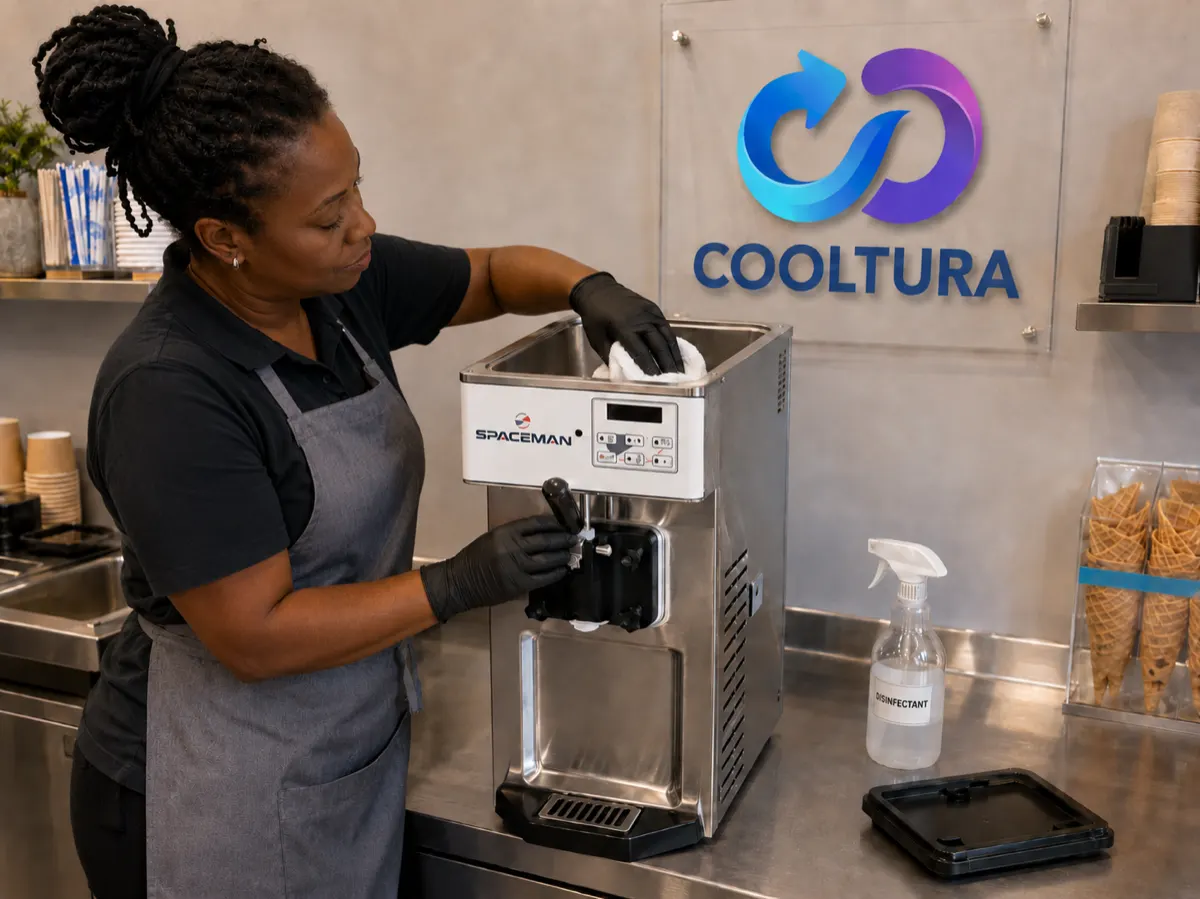
In the food sector, hygiene is non-negotiable. Period. When the health inspector comes into your shop – and that will happen, sooner or later – then you not only have to be clean, you also have to be able to prove it. Without any gaps.
That's exactly why automatic pasteurization in the Spaceman 6210B-C is, in my view, one of the most important features on the market. In this post I'll try to explain what the machine actually does technically, why that's such a game changer for operators, and from what point the investment truly pays off for you.
What pasteurization actually means
Pasteurization is no black magic. The process was developed in the mid-19th century by Louis Pasteur, hence the name. The logic is simple: you heat a liquid (in our case the ice mix) for a certain time to a certain temperature, and this heat kills off all relevant germs and bacteria. The dairy industry has been doing this for 150 years, and it works.
With automatic pasteurization in the Spaceman, it goes like this: the mix is heated to 68 °C in the cylinder, and this temperature is held for at least 30 minutes. After this cycle, the mix is microbiologically clean, without you having touched a single screw.
When does the process run?
You program a time. For most operators that's in the middle of the night, because no sales are happening then anyway. The machine starts automatically, heats the mix, holds the temperature for 30 minutes, then cools back down to operating temperature, and in the morning everything is ready to go again.
In practice that means: you come into the shop in the morning, open up, and the first customer can be served straight away. No cleaning, no preparation, no waiting time. Depending on the machine, you save 45–60 minutes every three days; over a six-day week that's roughly 2 hours of pure working time that creates far more value elsewhere.
What does this mean for the deep clean?
Important: automatic pasteurization does not replace the deep clean. But it considerably extends the intervals. Instead of cleaning every three days, with correct use one deep-cleaning cycle every 10–14 days is enough.
My tip from practice: schedule the deep clean on your weakest sales day. For most operators that's Monday. Two hours of preparation, disassemble all components, clean everything, reassemble, done. Compared to a 45-minute routine every three days, that's about 1–2 hours less work per week. Over a year that adds up to around 75 hours – that's almost two full working weeks you reclaim for yourself.
HACCP compliance: the underestimated advantage
Something that often gets lost in conversations with beginners: automatic pasteurization makes your HACCP documentation enormously easier. HACCP stands for "Hazard Analysis Critical Control Points" and is the standard against which the health inspector measures your hygiene.
The Spaceman machine logs every pasteurization cycle with temperature and duration. You can read this data out directly and file it in your HACCP folder. During an inspection you don't have to make anything up, keep anything manually, or maintain anything in Excel – the machine has produced the proof for you.
That really is a major advantage. I know operators who had problems with the health inspector because they couldn't keep their manual cleaning documentation gap-free. With automatic pasteurization you no longer have this problem.
Which machines have the feature?
In our Cooltura range: automatic pasteurization comes as standard on the Spaceman 6210B-C. The more compact entry-level model, the 6210-C, deliberately does without this function in order to keep the price low, but in return it costs you the manual cleaning every day.
Is the extra cost worth it?
Here's the honest math. The price difference from the 6210-C to the 6210B-C is around €2,500. That sounds like a lot, but in my view it isn't, if you factor in the following two points.
First, working time: 45 minutes per day, 6 days per week, 50 weeks per year – that's 225 hours of cleaning. If you value your time at just €20/hour, that's €4,500 worth per year. So the machine pays back the extra cost in the very first season.
Second, availability: an operation that has to clean for 45 minutes in the morning effectively opens 45 minutes later. If that costs you your early-customer rush, you're not just losing working time, you're losing revenue.
My tip: if you run the machine on at least 5 days a week, go for the 6210B-C. The few thousand euros are one of the best investments you can make in your shop.
Fun fact on the side
Something many people don't know: the UHT (Ultra-High-Temperature) heating we use for our Sunny's Soft Ice Liquid Mix works on the same principle as the pasteurization in the machine, just already at the factory. That's why the mix can be stored completely without refrigeration. Combined with the automatic pasteurization in the machine, you get maximum hygiene safety on both sides.
Conclusion
Automatic pasteurization is, in my opinion, by far the most important hygiene feature in the modern soft ice machine. It saves you working time, increases your availability, simplifies your HACCP documentation and protects you from costly hygiene problems. With regular operation, the extra cost pays for itself within a single season.
What the machine does technically, step by step
For the technically minded among you, a bit more detail on what actually happens in the cylinder. The automatic pasteurization runs in four clear phases. Phase one is the heat-up phase: the machine takes the mix from about 4 °C operating temperature up to 68 °C in a controlled way. Depending on the model, that takes between 30 and 45 minutes. Phase two is the holding phase, the actual pasteurization: 30 minutes of constant 68 °C. Phase three is the cool-down: the mix is cooled back to 4 °C, which takes another 60–90 minutes. Phase four is the return to standby mode.
In total, a complete pasteurization cycle takes around 2–3 hours. In the middle of the night you won't notice a thing. Power consumption: roughly 1.5–2 kWh per cycle, so at an electricity price of 35 cents, about 70 cents per night. That's ridiculously little, in my opinion, compared with what you save in cleaning working time.
What happens if the pasteurization fails once?
Actually a sensible question. The Spaceman machines have an error mode: if the cycle isn't completed successfully (for example because the power was briefly out), the machine displays a warning and you have to clean manually before you're allowed to sell again. That's intentional – hygiene safety takes priority over convenience. In my experience this happens at most once or twice a year, so it's really rare.
If you're unsure which machine suits your location, feel free to let us know. We advise honestly, even if in the end the smaller machine is the right choice for you.

About the author
Florian Werner
Kühler Kopf mit großer Leidenschaft fürs Eis
Geschäftsführer von Cooltura und leidenschaftlicher Blogger vom Kopf bis zur Waffelspitze.
Ready for your soft serve concept?
Start now with the right machine
Discover our professional Spaceman soft serve machines and find the perfect model for your business.
More articles
You might also like
 Practice
Softeis im Winter: So bleibt deine Maschine von Oktober bis März rentabel
 Practice
Soft serve manufacturers compared: Who you can actually get in Germany
 Industry