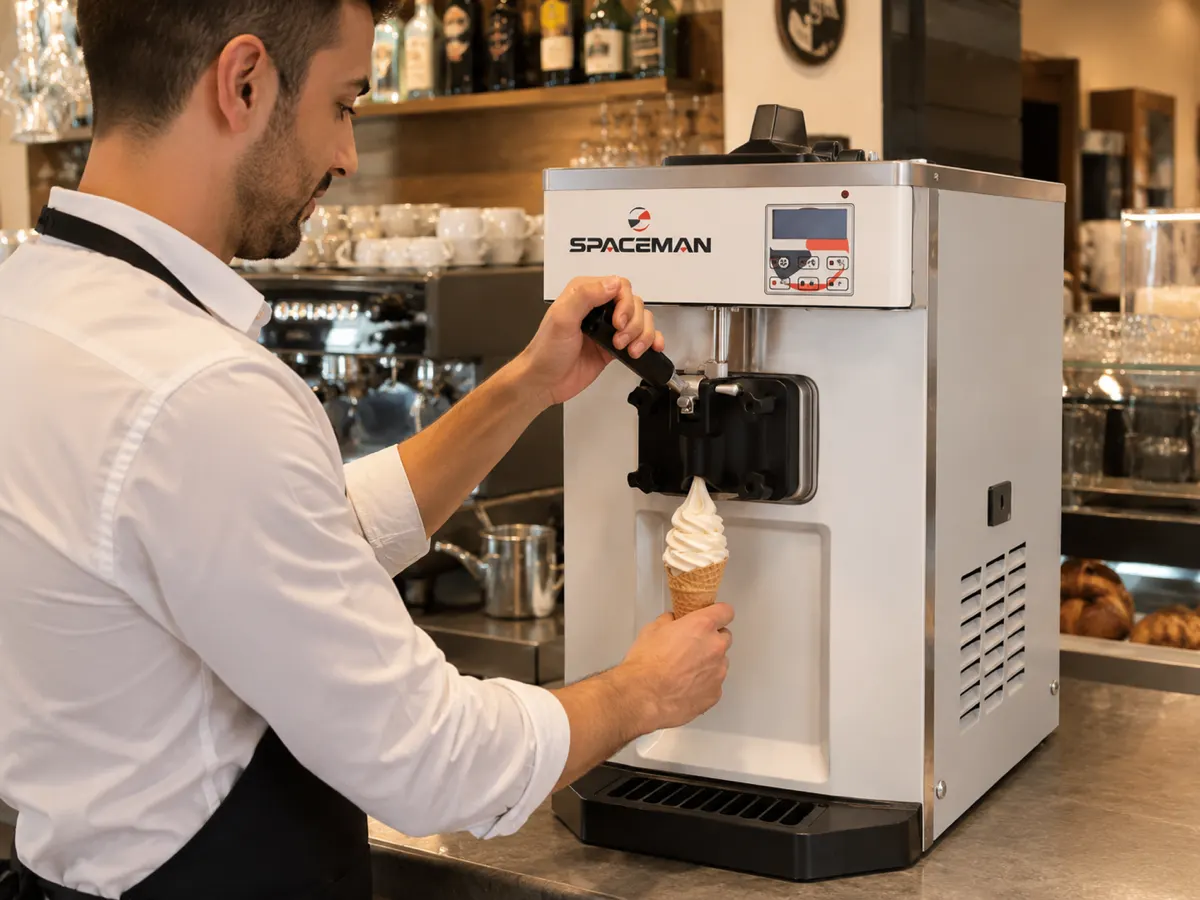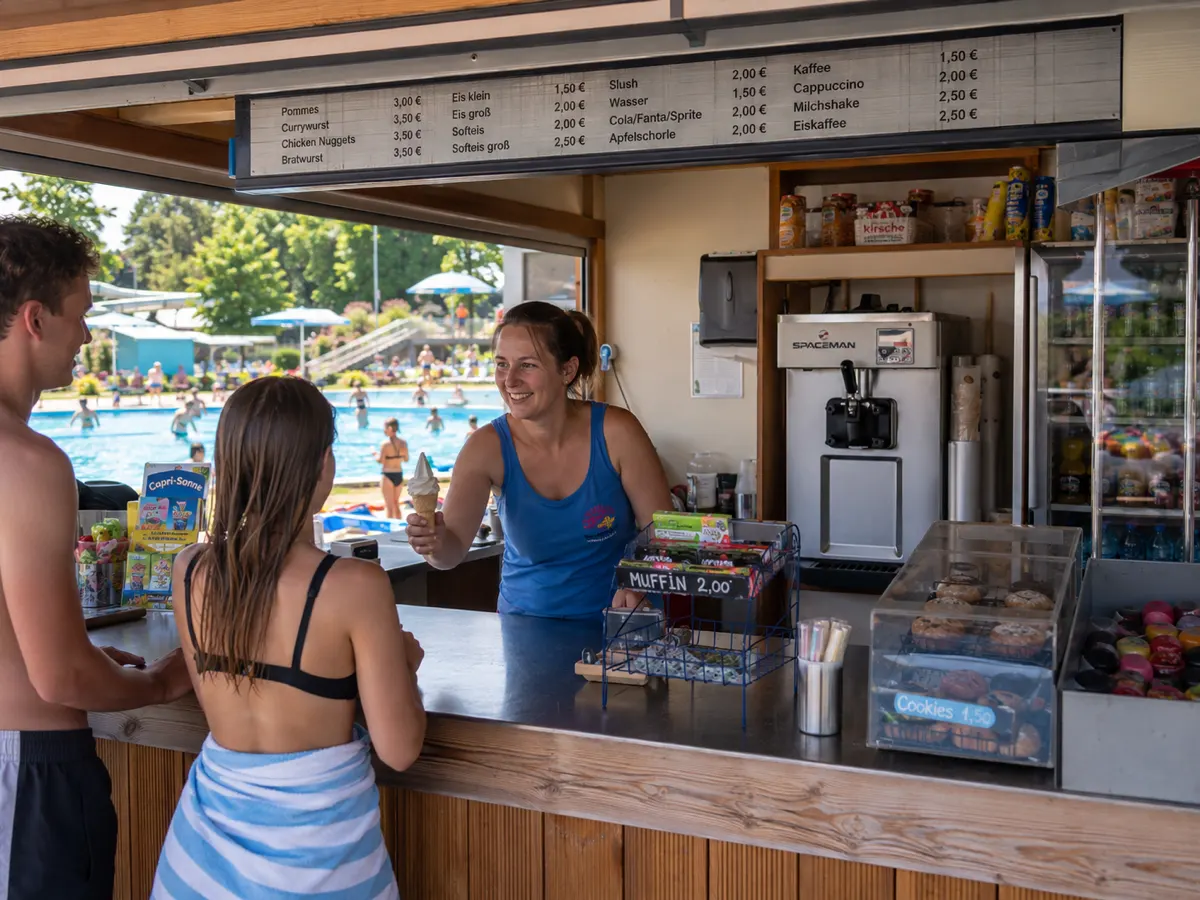

Anyone looking for a soft serve machine for the counter ends up at these two names sooner or later. Carpigiani stands for Italian ice cream engineering since 1946, Spaceman for a broad range with open prices and technology built for continuous service at the counter. Both make machines you can sell good soft serve with. Almost everything else differs: the purchase price, the cleaning effort, the service network and the question of what the machine is still worth in five years.
Two companies serving the same need
Carpigiani is based in Anzola dell'Emilia near Bologna, founded in 1946 by the brothers Bruto and Poerio Carlo Carpigiani, with additional production in Forlì, in Gandia in Spain and in Zhongshan in China. Since 1989 the company has belonged to the Ali Group in Milan, one of the largest groups in kitchen and food technology. The figures match: around 220 authorised dealers, representation in over a hundred countries, more than 500 service centres and machines in over 200,000 ice cream parlours, pastry shops, cafés and restaurants.
Spaceman has been building freezing technology since the nineties. Production runs in Daixi near Huzhou in Zhejiang province across 26,670 square metres, the head office is in Shanghai, the American company in Loveland, Colorado. The company is a volume manufacturer and presents itself as one: a broad range from countertop to floor-standing units, all designed for continuous service at the counter, without claiming to serve the world of artisan gelato alongside it.
One difference stands out before the first conversation. At Spaceman the price is in the shop, with model designation and data sheet next to it. At Carpigiani you get it through the authorised dealer. For comparing two quotes that is a noticeable difference, and for your own calculation too.
How robust these machines are in continuous operation is shown by their customers. Spaceman is an official supplier to McDonald's and KFC in China, with over 1,000 machines in use at each chain. What that reference proves, it proves about the machine: passed hygiene and quality audits and spare parts that stay available for years.
So a broadly positioned traditional brand meets a focused volume manufacturer. The need is the same, everything else is decided by the criteria you go through when buying anyway.
What the machines cost
Open prices are the exception in this market. Carpigiani does not publish new prices, you get those through the authorised dealer. One German specialist dealer lists the 191 Steel with pump at 13,054.90 euros net and with pasteurisation at 14,978.65 euros net. The manufacturer's refurbished catalogue lists a factory-reconditioned 191 Classic SP P at 11,000 euros.
Against that stands a pasteurising countertop unit from our range at 8,999 euros net. Between the two machines with one flavour, pump and pasteurisation there is therefore a gap of just under 6,000 euros. Only purchase prices are being compared here. The manufacturers measure output per hour on different bases, so that figure cannot be set against each other.
A second point belongs alongside it, otherwise the picture tilts: for Carpigiani there is a lively used market that puts the new price into perspective. Anyone who wants to buy used and can judge condition will find offers there below a new Spaceman countertop unit. What that costs in detail and what you buy along with it is further down in the section on resale value.
Pump or gravity: The difference ends up in the cup
The most important technical difference lies in the design. A gravity machine lets the mix run from the hopper into the cylinder. A pump machine pushes it in and whips air into it in the process. With gravity, overrun is around thirty to thirty-five percent by design, with pump machines it is adjustable in a range of roughly ten to eighty percent.
For you that means two things. More overrun means more volume from the same amount of mix, so more servings per canister. Less overrun means denser ice cream with a stronger taste impression. Gravity units deliver the denser product, have fewer components and cost less. Pump machines have more parts in return, which want to be taken apart and disinfected at every strip-down clean, so at least every 72 hours.
Carpigiani builds both in the 191 series: gravity with an 18 litre tank or pump with a 12 litre tank, in the same base model. Anyone deliberately looking for a gravity unit because they want the denser ice cream will find it there and not with us.
The models we carry at Cooltura all work with a pump, which makes overrun an adjustment rather than a design decision. You run it low for a dense, dark product, for açaí or frozen yogurt for instance, or high for more servings from the same canister. With a gravity unit you commit at the moment of purchase.
Pasteurisation: The point is the cleaning interval
Automatic pasteurisation means the machine heats the mix in the cylinder itself and holds the temperature. In daily operation what counts above all is the consequence: the full strip-down every 72 hours is no longer needed.
Here Carpigiani is ahead. For the self-pasteurising SP models the heat treatment allows cleaning intervals of up to 42 days. The pasteurising Spaceman versions for Europe work on a 21 day cycle. If you budget two working hours for a strip-down, that is a measurable difference in staff time across a season, and it falls in favour of the Italian machine. Both figures are what the manufacturer permits. What you actually run is set by your own hygiene concept.
On the price for this function Spaceman is just as clearly ahead. A pasteurising countertop unit costs 8,999 euros with us, the comparable Carpigiani machine is listed by the specialist dealer at 14,978.65 euros. That is forty percent difference for the same function, and that amount is due on the day of purchase, while the saved cleaning hours spread over years.
| Criterion | Carpigiani | Spaceman |
|---|---|---|
| New price, countertop unit with pasteurisation | 14,978.65 EUR net at the specialist dealer | 8,999 EUR net |
| Prices publicly visible | no, only via the authorised dealer | yes, in the shop with price |
| Overrun | depends on design, fixed with gravity | adjustable, roughly 10 to 80 percent |
| Design | 191 either gravity (18 L tank) or pump (12 L tank) | pump throughout the German range |
| Cleaning interval with pasteurisation | up to 42 days | 21 days |
| Consistency control | Hard-O-Tronic, regulates via measured viscosity | overrun adjustable in steps |
| Service network | over 500 service centres worldwide, around 220 authorised dealers | certified service partners, plus any independent refrigeration engineer |
| Spare parts | via authorised dealer and the factory technical service | from stock in our shop |
| Spare parts warranty at the dealer | via the authorised dealer | 24 months |
| Factory used-machine programme | refurbished catalogue with prices and one year of warranty | none |
| Used offers in Germany | several specialist dealers, 6,500 to 10,860 EUR net for the 191 | isolated cases |
What wear parts and working time add
The purchase price is the visible part of the bill. The invisible part consists of blades, seals and working time. On a pump machine that means scraper blades at least every three months, drive shaft seals and the O-rings of the draw valve every one to three months, plus fresh food-safe grease on the seals at every strip-down clean. This applies to the machines of both manufacturers as soon as a pump is involved. But it is an item you should plan for rather than discover in your first year of operation.
Service and spare parts in Germany
Carpigiani maintains over 500 service centres worldwide, in Germany established authorised dealers work with the brand, Briewig Kälte for instance since 1995, plus Frisani in Schleswig and the Eistechnikcenter in Luckenwalde. That is a well-practised network, and at the same time you stay tied to it: parts and service run through the contractual route.
With Spaceman it runs through the dealer, and in your case that is us. Spare and wear parts come from the manufacturer and sit in our warehouse, you can reorder them in the shop at any time, from the tune-up kit to a single scraper blade. Warranty and guarantee run through our certified service partners, technical support by phone and email. The spare parts warranty is 24 months and therefore twice as long as the one-year factory warranty.
Resale value: What the machine still fetches in five years
This is where a calculation is most feasible. Against a new price of roughly 13,000 to 15,000 euros net for the 191 series stand used offers: a 191 P/SP at a German specialist dealer for 6,900 euros, a 191 P with one year of guarantee at another for 10,860 euros, a workshop-reconditioned 191 psp from 2018 on a used platform for 6,500 euros. In the manufacturer's refurbished catalogue 191 units sit between 9,500 and 11,000 euros. That gives an order of magnitude of roughly fifty to eighty-five percent of the new price, depending on the depth of reconditioning and the warranty.
This is reinforced by Carpigiani working the used market itself. Every machine in the refurbished programme is repaired with original parts, has to pass the same function tests as a new one and comes with one year of warranty. That is a publicly visible price reference the whole market orients itself by, and it supports the value of your machine even when you sell privately.
For Spaceman there is no comparable used market in Germany. On resale you meet isolated cases rather than an established market with reference prices. Anyone who counts firmly on resale should put that into the calculation.
Against this point, though, stands the other side of the same calculation. The just under 6,000 euros of price difference on the pasteurising countertop unit are certain on the day of purchase. The residual value is an estimate over five or ten years, and it depends on the condition of the machine, on demand at that time and on whether you sell at all. Most machines run until they are no longer economical to keep. Anyone calculating tightly is better off having the money in the business now.
What belongs in every quote
Regardless of the brand there are four points you should get in writing. The first is the refrigerant. R-404A may no longer be used in Europe for new commercial refrigeration applications, since 2020 only reclaimed material is permitted in servicing, and the successor R-448A is likewise an F-gas with global warming potential. Have the specification confirmed for the specific machine. Above a certain charge quantity the annual leak check is added, and that is a recurring item too.
The second point is the scope of the guarantee: parts alone or parts and labour, how long on the compressor, and what maintenance you have to document for it. The Spaceman factory warranty is one year, our spare parts warranty 24 months. The compressor warranty requires an annually performed and documented condenser cleaning. The third point is the fault case: what happens when you actually do have a technical problem with your machine? The fourth is the prices of the wear parts for one operating year, so scraper blades and seals. You get those four details with one phone call, and over the term they often move more money than the discount on the purchase price.
Which brand pays off for whom
If you are buying new, Spaceman is the more sober calculation in most cases. 8,999 against 14,978.65 euros for a pasteurising countertop unit is just under 6,000 euros that stay in your business on the day of purchase. In a young operation that amount often decides whether the machine arrives at all.
Three further points speak for it. In a fault you are not dependent on a single route: you get parts from our stock, and in principle any refrigeration engineer can work on the machine. Overrun is adjustable because all models run with a pump, so you get more servings from the same canister or a denser product, depending on your concept. And these series are built for heavy use, as the customers in systemised hospitality show.
The most common objection is the cleaning interval, and that can be calculated. 21 instead of 42 days means around seven additional strip-downs a year across 300 operating days. At two working hours and an hourly rate of twenty euros that is about 280 euros a year, around 1,400 euros over five years. A real item you should plan for. But it sits clearly below the just under 6,000 euros of price difference, and it spreads over years, while the purchase price is due immediately.
Carpigiani pays off where this calculation does not hold. If the residual value is firmly in your budget because you might rebuild or stop in ten years, the used market speaks for the brand. And if you make artisan ice cream anyway, you get batch freezer, pasteuriser and soft serve machine from one house.
Neither manufacturer publishes failure rates or mean service life. Anyone quoting you a figure on that should be able to say where it comes from.
All prices are net and reflect the status as of 27 August 2026. The Carpigiani prices quoted come from the publicly visible offer of a German specialist dealer and from the manufacturer's refurbished catalogue and may change at any time.

About the author
Florian Werner
Kühler Kopf mit großer Leidenschaft fürs Eis
Geschäftsführer von Cooltura und leidenschaftlicher Blogger vom Kopf bis zur Waffelspitze.
Ready for your soft serve concept?
Start now with the right machine
Discover our professional Spaceman soft serve machines and find the perfect model for your business.
More articles