
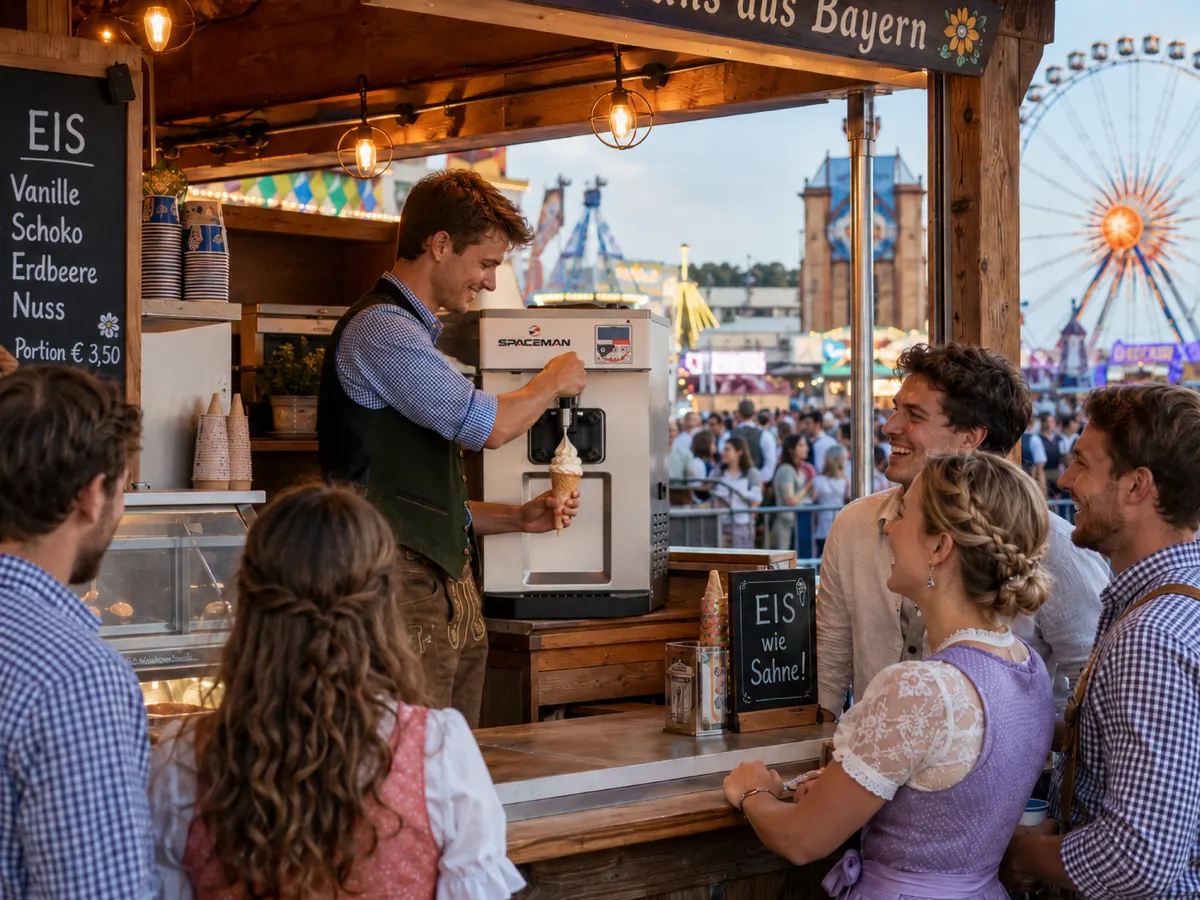
I admit, I was skeptical at first. When we started trading soft ice machines at Cooltura a few years ago, we thought: "Well, a summer product, somehow classic, somehow a thing of the past." Back then you ate soft ice at the East German ice cream parlor or at the village fair. Period. Today, three years later, I can honestly say: that was a pretty wrong assessment.
The market has genuinely turned. And 2026 is, in my opinion, exactly the point at which the old prejudices finally fall away. In this post I'll try to sum up for you what we're seeing from our sales figures, from conversations with customers and from industry data, and why now is, in my view, the best time to get in.
The market: double-digit growth that won't stop
The European soft ice market has been growing in double digits for years. That sounds like a marketing figure at first, but it's actually solid. We notice it directly: compared with the previous year, we sell roughly 40 % more machines at Cooltura, and our powder orders – which are a good indicator of real consumption – are running even stronger.
What you can take away from this: this isn't a hype that tips over again next year. This is a genuine market shift. Consumers are rediscovering soft ice as a premium product, and new buyer groups are coming on board – gas stations, bakeries, swimming pools, even hotels.
Trend 1: The season is getting longer
This is, in my view, the most exciting trend. For a long time soft ice was a pure summer product – May to September, then a break. My first Cooltura customer in my home village really did cover up his machine in October and bring it back out in April. Today that's completely different.
What's happening: indoor locations are entirely season-independent. A café, a hotel lobby area, a shopping center – there's no winter there. Whoever sells soft ice there has a 365-day season. Even classic kiosks are experimenting with winter offerings. A warm waffle with cold soft ice is seriously great in November – the contrast works, customers love it, and you keep earning money when your competition is already in winter hibernation. I know an operation in Straubing that has now been open year-round for two years and even reaches 60 % of its summer revenue in winter. He wouldn't have dreamed of that three years ago.
Trend 2: Premium beats discount
This is the market logic I discuss most often with beginners. Many think: "I have to be cheap, otherwise nobody buys." In reality it's exactly the other way around. In 2026, consumers are willing to pay more for quality, even for an ice cream. Most customers consider a serving for €4.50 to be entirely fair, as long as the ice cream tastes good, is well presented and feels properly made. Customers don't compare it with the €1.20 ice-cream-on-a-stick from the supermarket. They compare it with the cappuccino they just had beforehand for €4.90.
You can actively use this trend: organic ingredients, homemade toppings, waffles from a regional artisan producer. That sets you apart from the competition, justifies higher prices, and your margin grows nonetheless, because the surcharge on your purchasing costs is smaller than on your selling price.
Trend 3: The social media effect
In my view, the most underestimated trend. Soft ice is photogenic. The tall swirl, the tip, the cone – that works on Instagram and TikTok like hardly any other product. A few weeks ago I spoke with a kiosk operator in Cham. He's had a machine since May. A customer posted a photo of his soft ice on TikTok – 80,000 views in a week. Afterward he had weekend customer flows from three districts. Without a single advertising euro. That's the free marketing machine that no budget in the world can replace.
My tip: invest a bit of time in presentation. A proper cone. An even tip. A color-coordinated topping. If the product looks good, the customers do the advertising for you.
Trend 4: New buyer groups
What we're seeing particularly strongly at the moment: it's no longer just ice cream parlors buying machines. We sell machines to gas stations, to bakeries, to swimming pools, even to individual supermarkets. Each of these industries has recognized that soft ice works as a footfall driver while at the same time earning really good money.
This changes the market for you as a beginner: less risk, because more industries are involved and the market as a whole is therefore growing. More validation, because you're no longer "the weirdo with the ice cream machine," but part of a clear trend.
Why start now?
Long story short: the combination of rising demand, a lengthening season, customers' willingness to pay premium prices and the enormous marketing power of social media makes 2026 a really good time to get in. Whoever starts now positions themselves ahead of the broad wave, and can work profitably from the very beginning.
The numbers we're seeing at Cooltura are pretty clear: operators who start in spring typically reach the break-even point on their machine costs within the first 3–4 months. After that, every serving is pure profit. So with a four-thousand-euro machine, we're talking about an investment that pays for itself within the same season.
What else I'd pass on to you
I'm seeing right now that many beginners still don't take the leap, because they're waiting for the "perfect moment." In my view there's never one. You'll always find arguments for waiting another month – summer's half over, interest rates are high, your tax advisor hasn't said yes yet, there's always something.
My suggestion: if you have an idea, a suitable location and the budget for a machine plus three months' supply of materials, get started. You'll make mistakes in the first few weeks, that's normal. But every day your machine isn't up and running, someone else is earning the money you could have earned.
What we're seeing internally at Cooltura
Fun fact on the side: in our Cooltura team we introduced an internal indicator at the start of 2026 that we call the "machines-to-inquiries ratio." We measure how many consultation conversations we need before a machine is sold. Two years ago this ratio was around 1:8, so for every eight consultations there was one sale. Today it's at 1:3. The customers who talk to us have already engaged more deeply with the topic beforehand, come with more concrete ideas and decide faster.
In my view, that's the best indicator that the market is maturing. Soft ice is no longer the exotic niche product for a few food-truck pioneers; it's a serious business option that is being seriously examined in more and more industries.
If you have questions, feel free to let us know – at Cooltura we also advise honestly, even if in the end no machine ends up at your place. I really do believe the market is big enough for everyone who wants to get in now.

About the author
Florian Werner
Kühler Kopf mit großer Leidenschaft fürs Eis
Geschäftsführer von Cooltura und leidenschaftlicher Blogger vom Kopf bis zur Waffelspitze.
Ready for your soft serve concept?
Start now with the right machine
Discover our professional Spaceman soft serve machines and find the perfect model for your business.
More articles
You might also like
 Industry
Carpigiani or Spaceman: Which machine suits which operation
 Industry
What a soft serve machine really costs over five years
 Industry